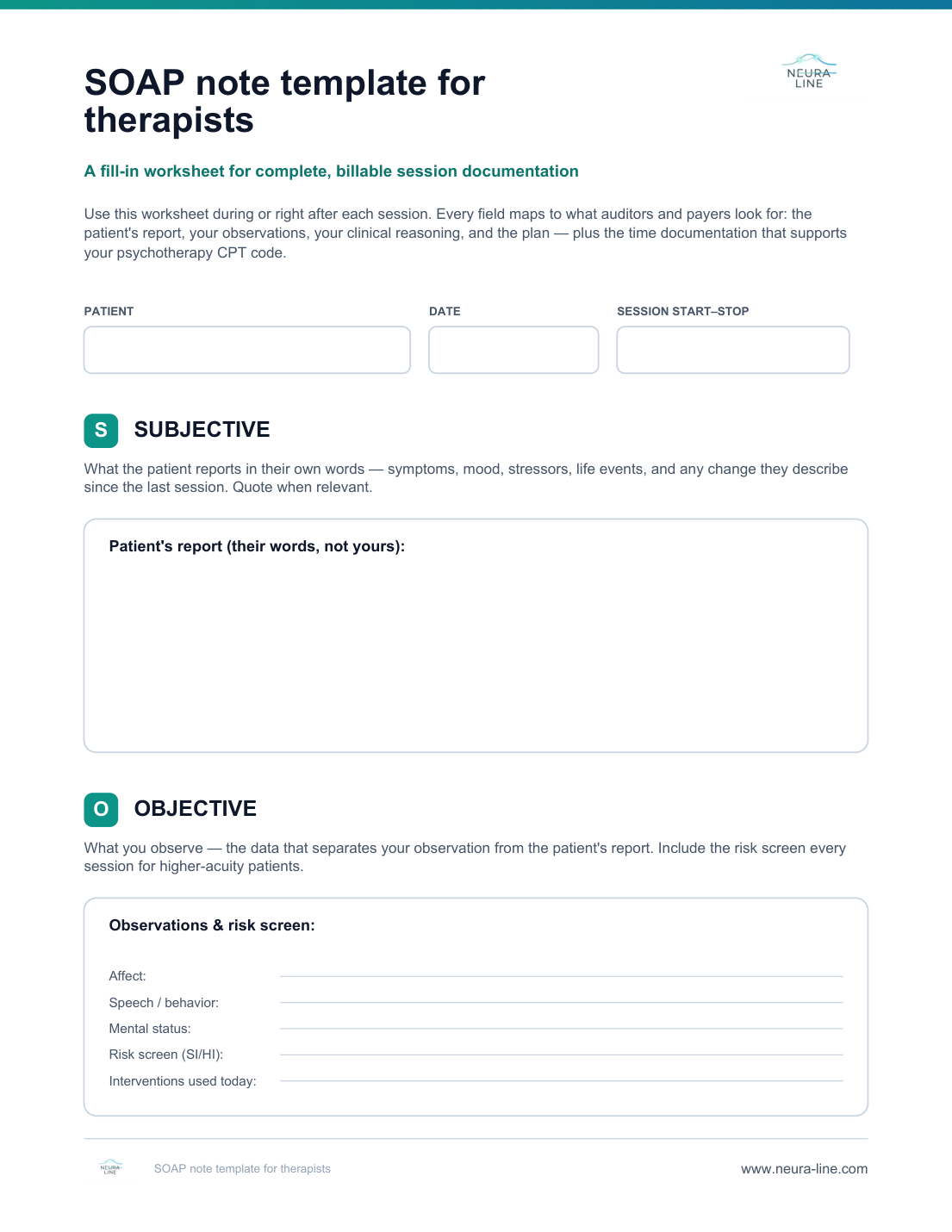
SOAP Note Template for Therapists
A branded 3-page fill-in worksheet: S/O/A/P prompts, labeled objective fields with risk screening, session time documentation with the CPT reference table, and a pre-signature documentation checklist.
Printable clinical worksheets, practice management templates, and documentation guides for therapists and counseling practices.
Fill-in documentation worksheets you can print and use with patients
Superbills, GFEs, and intake templates for running your practice
In-depth articles on billing, compliance, and documentation

A branded 3-page fill-in worksheet: S/O/A/P prompts, labeled objective fields with risk screening, session time documentation with the CPT reference table, and a pre-signature documentation checklist.

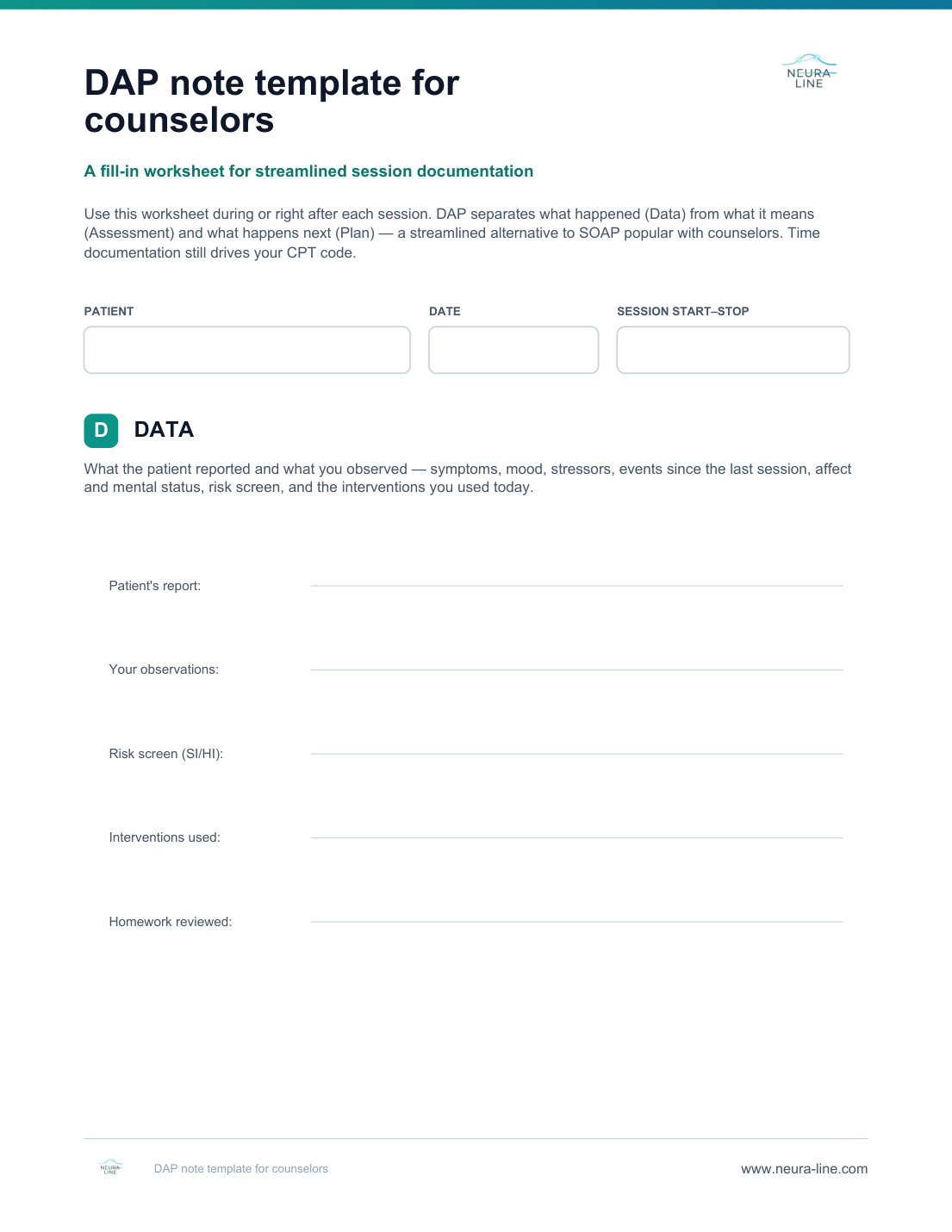
A streamlined Data / Assessment / Plan worksheet with labeled data fields, assessment and plan boxes, session time + CPT reference, and an intervention word bank for billable progress notes.

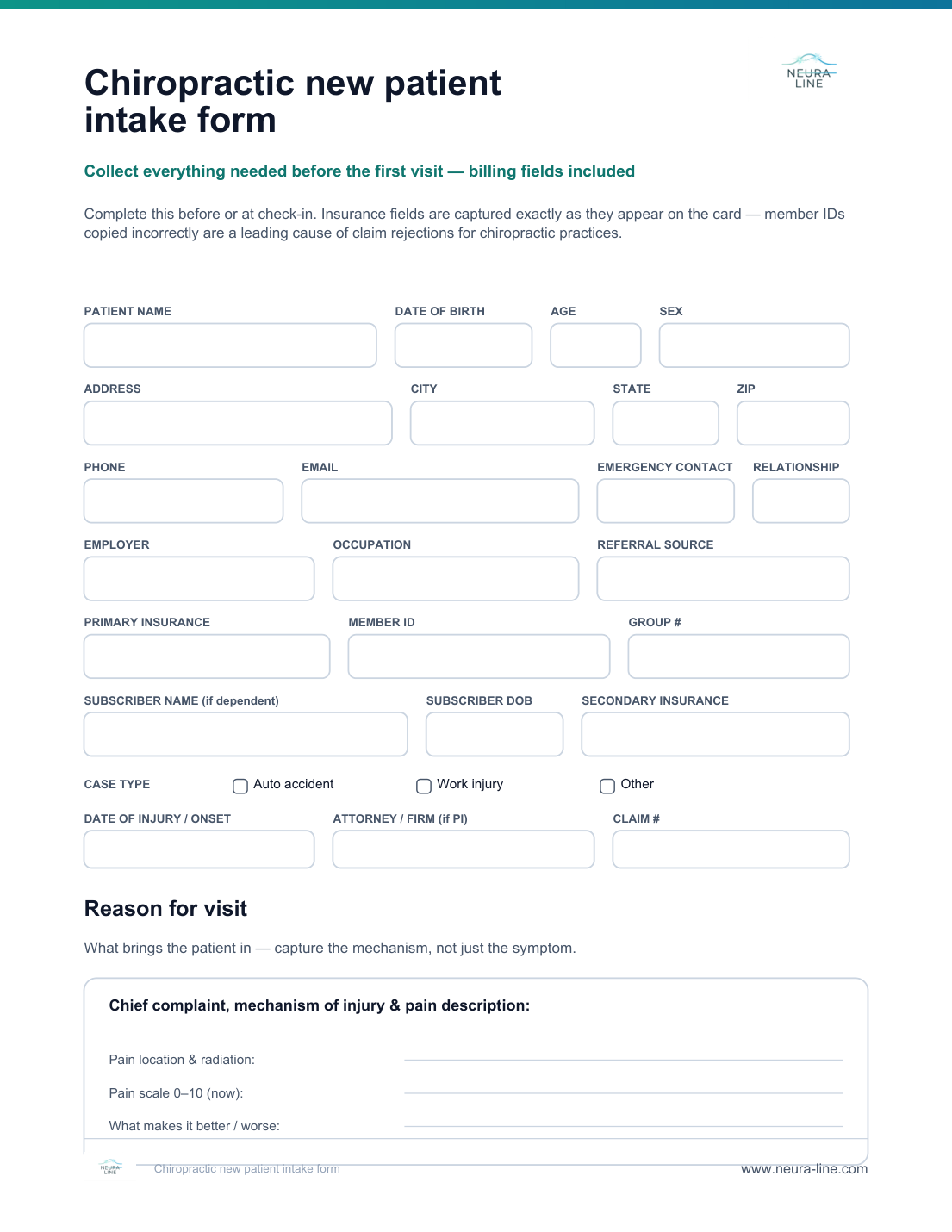
Demographics, insurance fields captured exactly as printed on the card, auto-accident / work-injury case type, health history, red-flag review of systems, and a pain & function baseline.

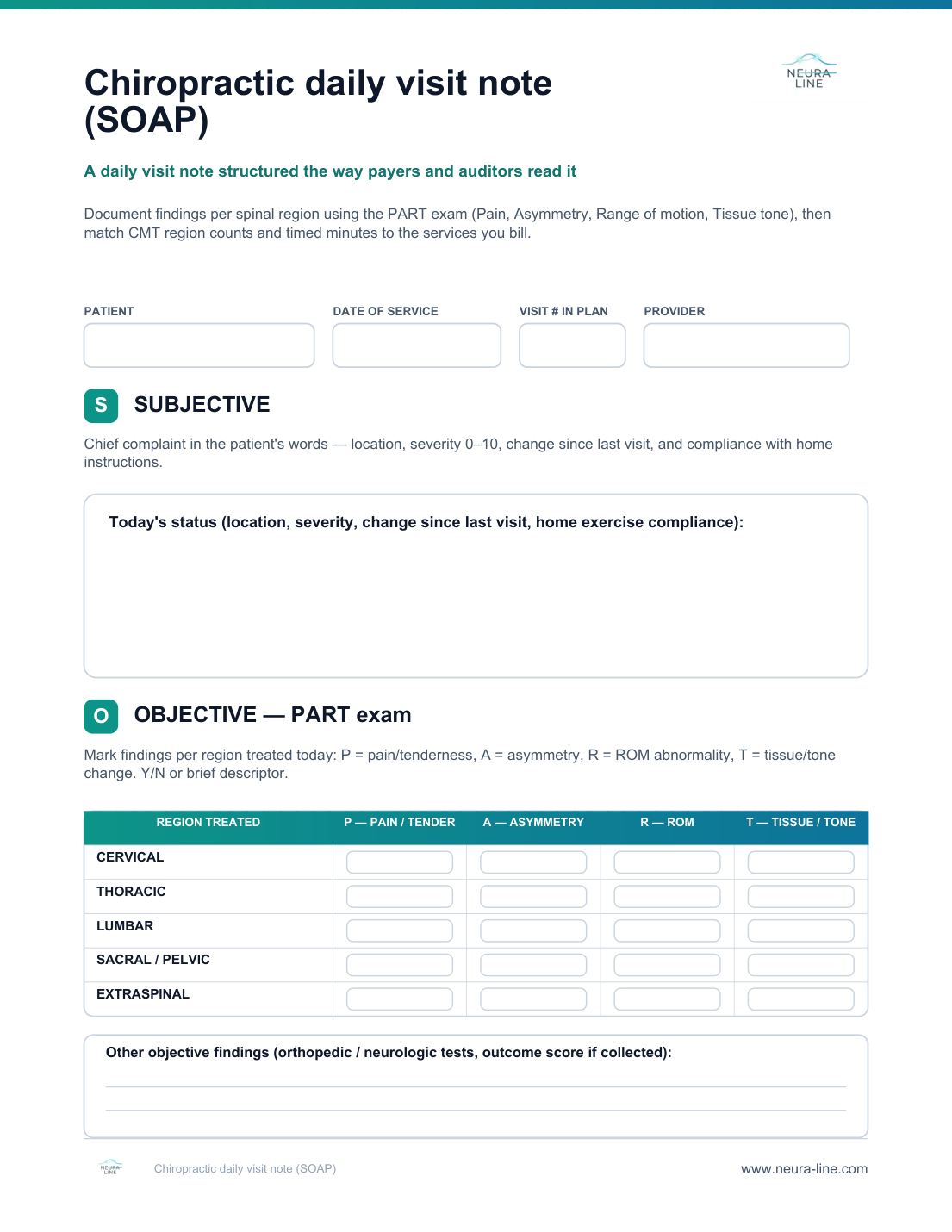
Daily visit note with the PART exam per spinal region (Pain / Asymmetry / ROM / Tissue), CMT 98940–98942 and timed-therapy CPT reference, plus a pre-signature billing checklist.

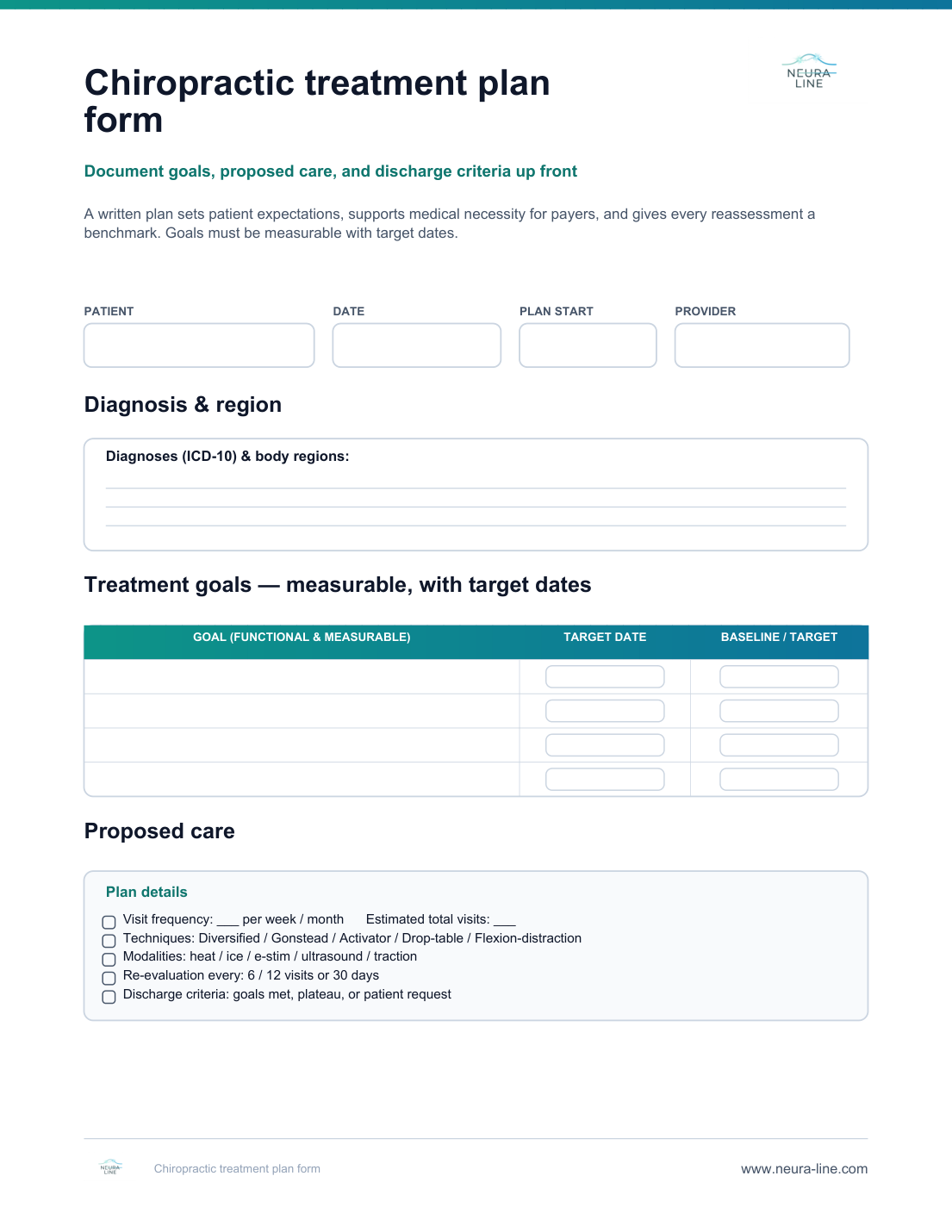
Measurable goals with target dates, proposed care details, patient agreement with signatures, a visit-by-visit progress log, and re-evaluation decisions (continue / modify / discharge).

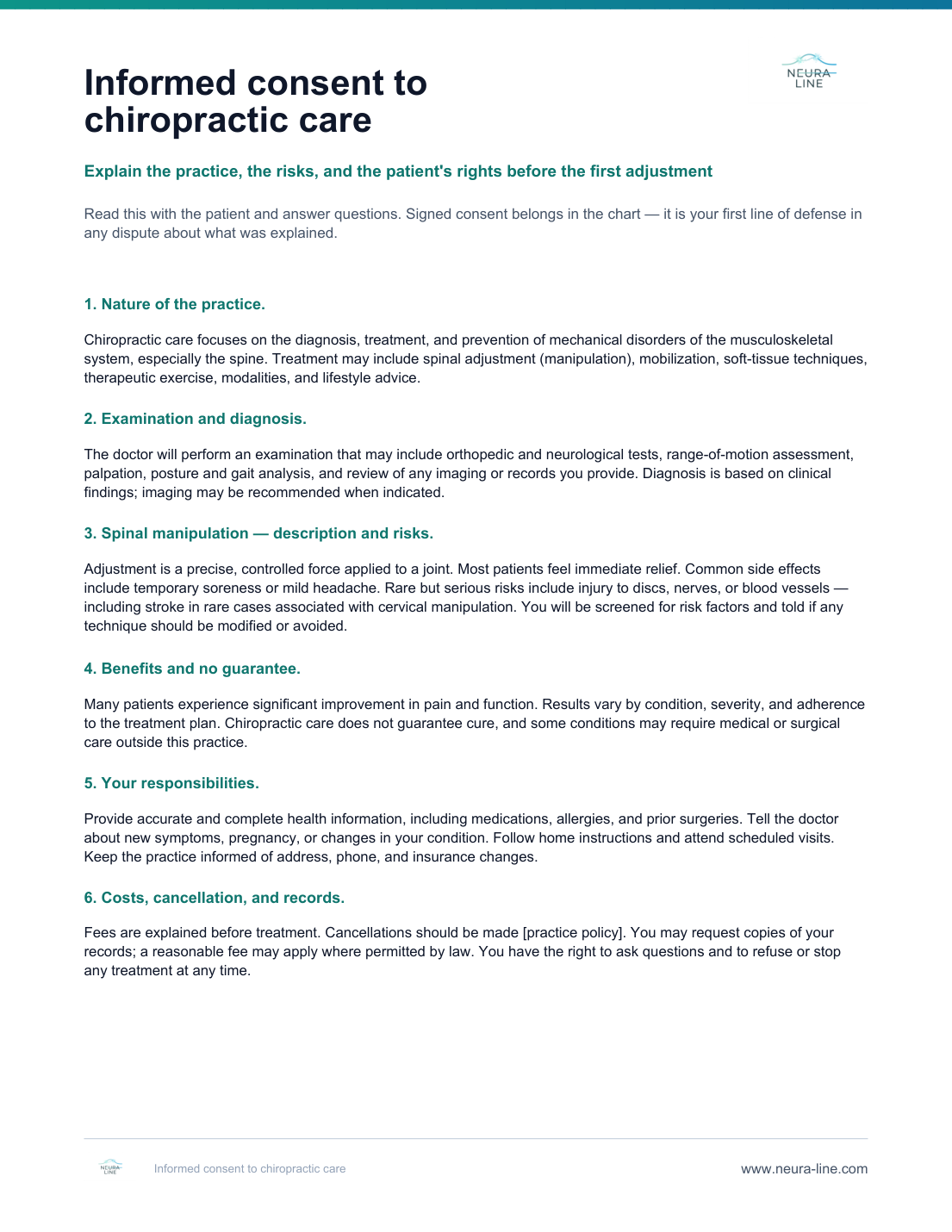
Plain-language consent covering the exam, spinal manipulation risks and benefits, patient responsibilities, costs, and voluntary participation — with patient, witness, and provider signature lines.

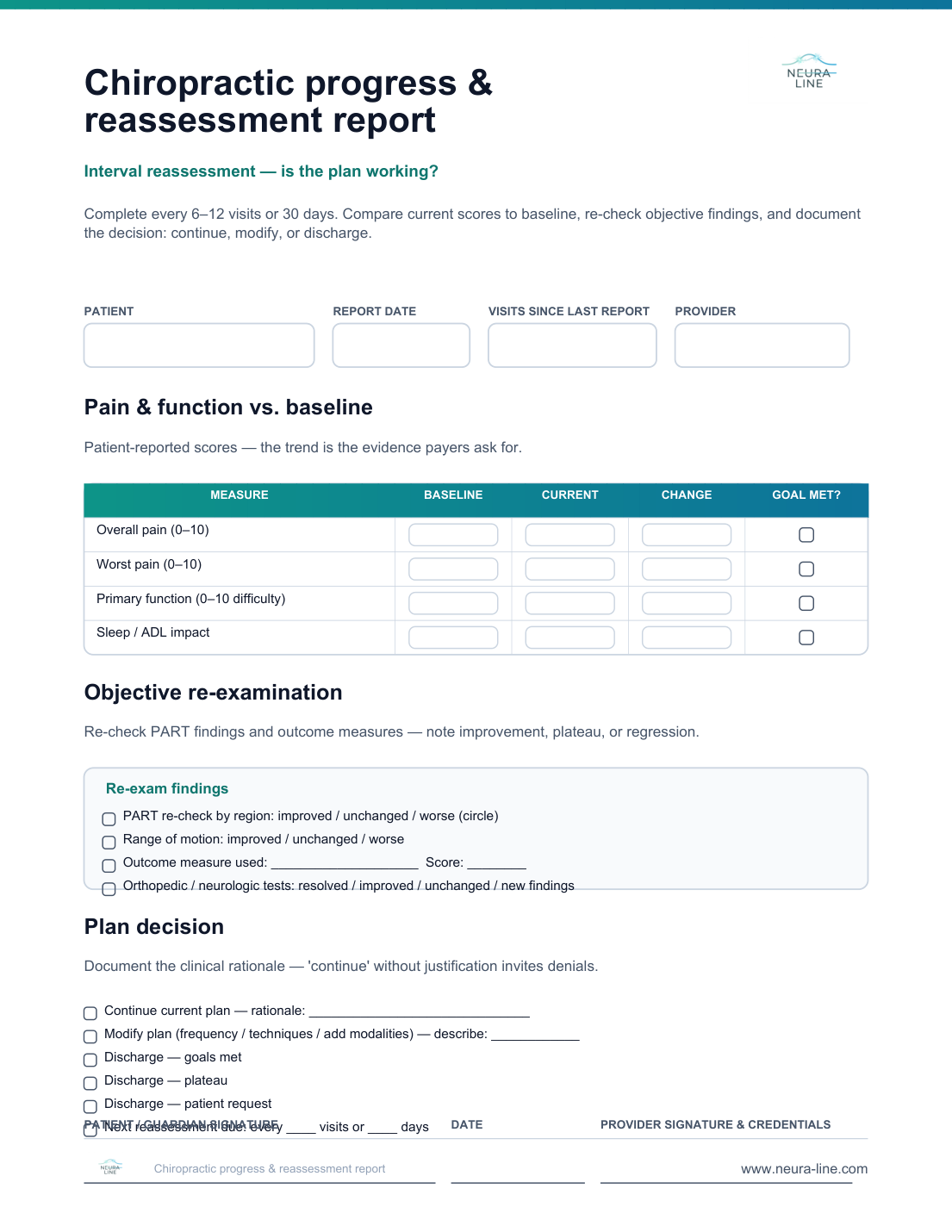
Interval reassessment with pain scores vs. baseline, objective re-exam findings, outcome-measure tracking, and a documented continue / modify / discharge decision.

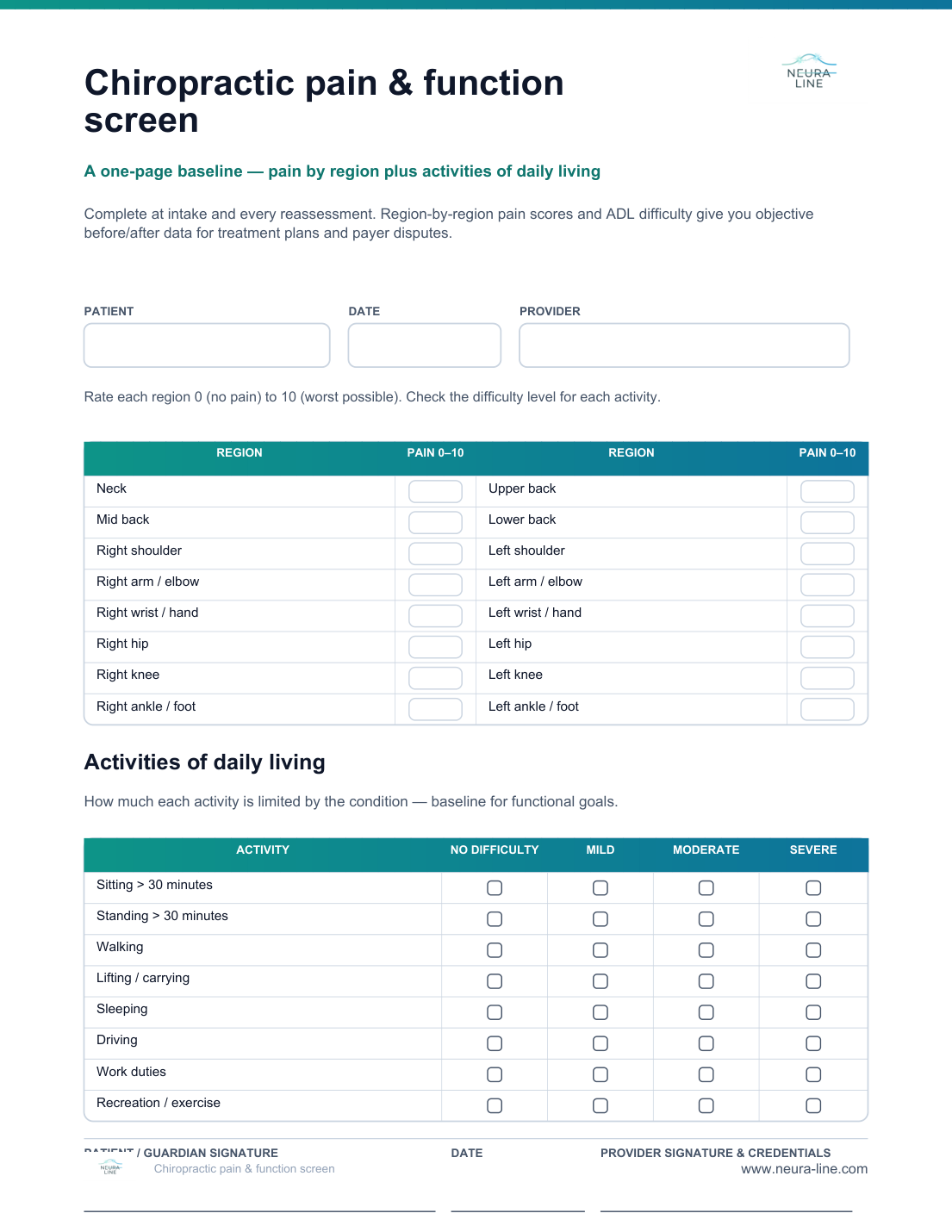
One-page baseline: pain 0–10 for 16 body regions plus an activities-of-daily-living difficulty grid — objective before/after data for plans and payer disputes.

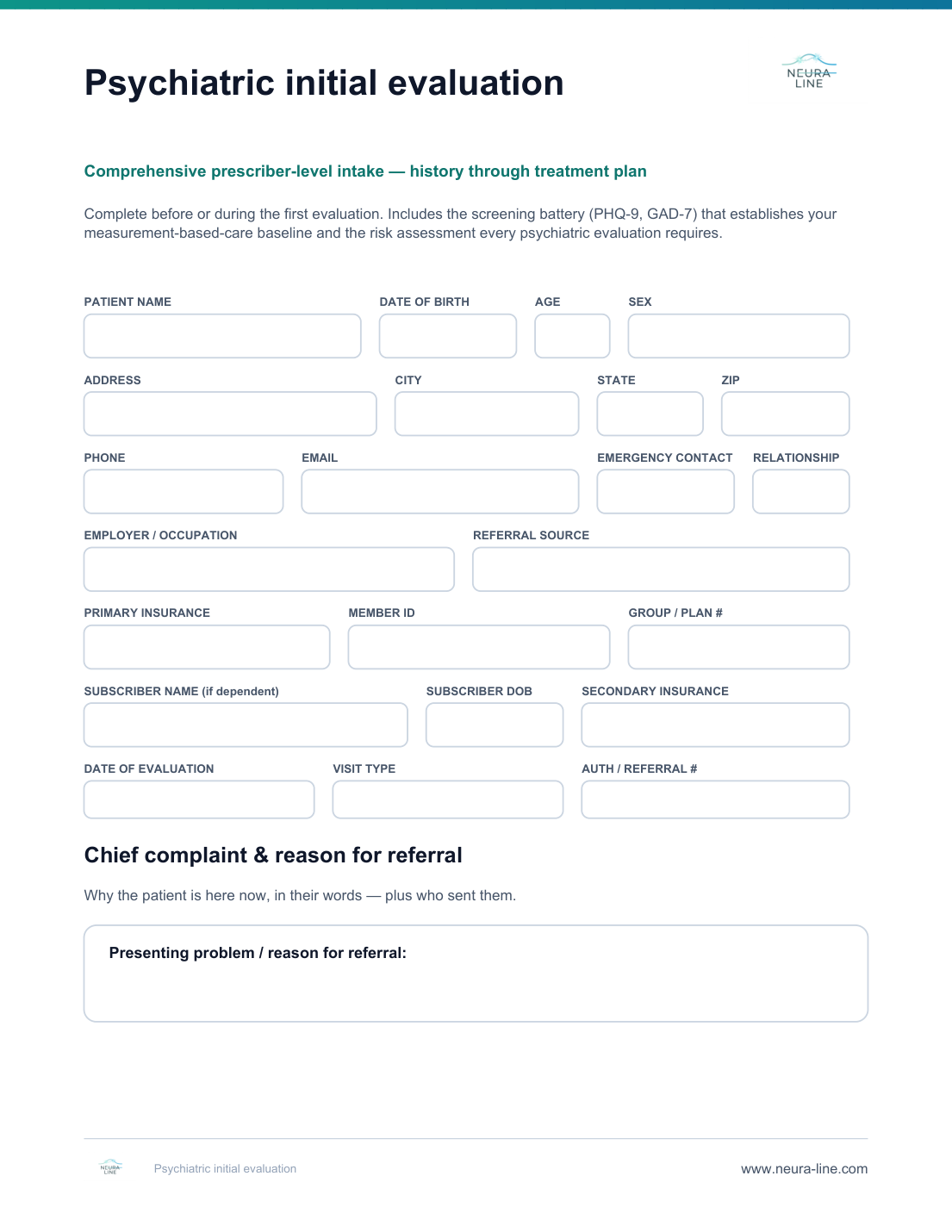
Comprehensive 5-page prescriber intake: demographics and insurance, HPI, psychiatric / substance / medical / family / social history, full mental status exam, suicide risk assessment, PHQ-9 + GAD-7 baseline, diagnostic impression, and initial plan.

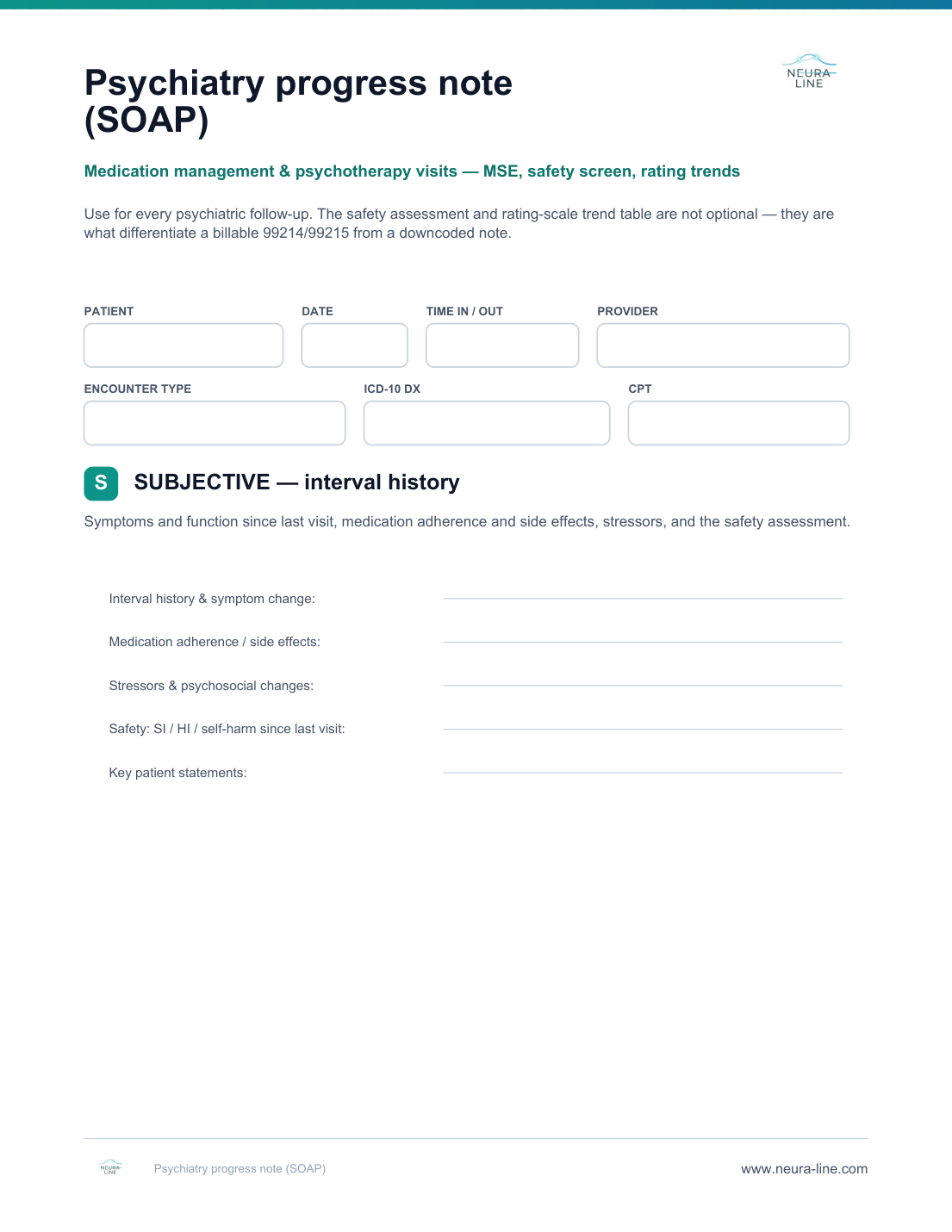
Follow-up visit note with interval history, safety assessment, brief MSE, PHQ-9 / GAD-7 trend table, diagnosis status, medication management, psychotherapy add-on CPT reference, and plan.

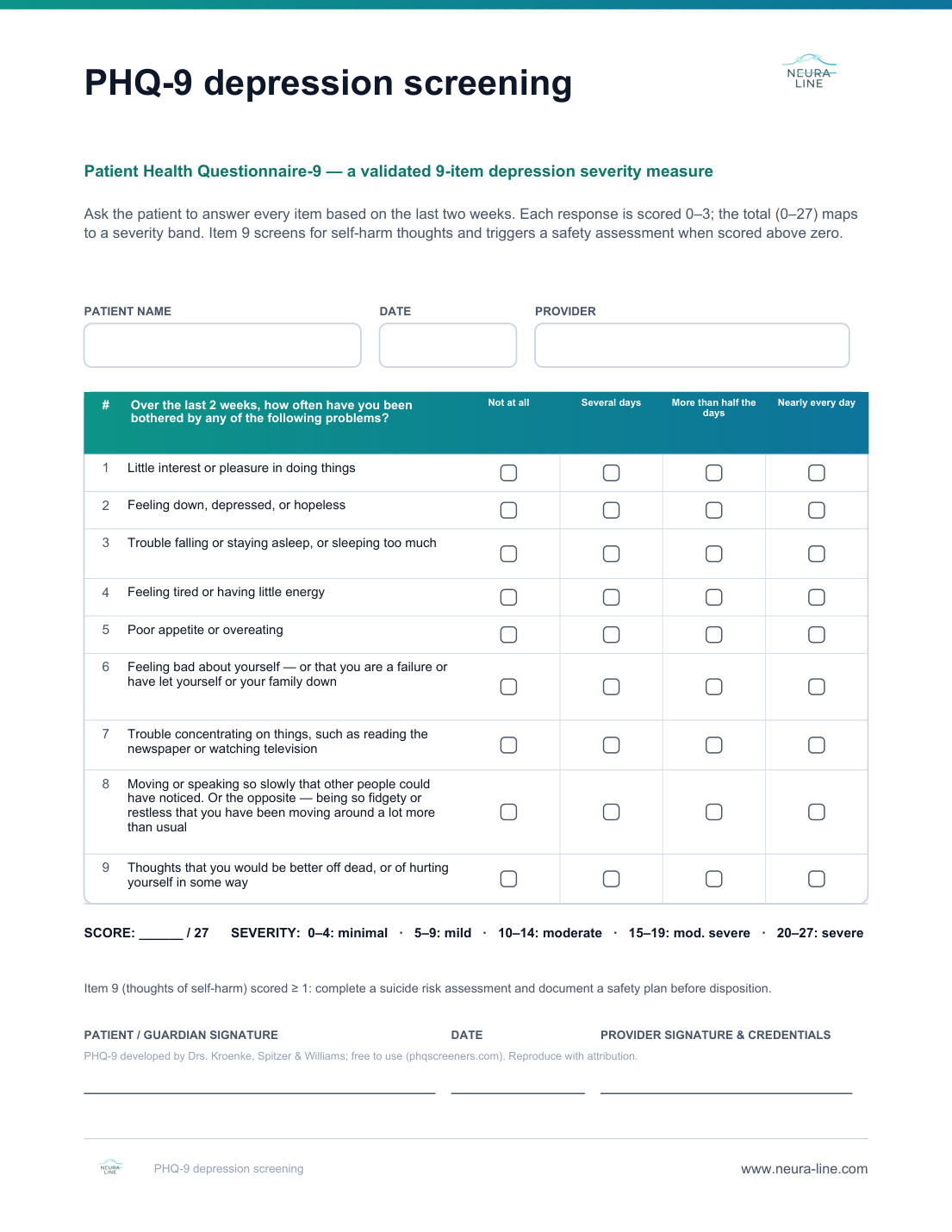
The validated 9-item depression measure with 0–3 response columns, severity bands (0–27), and the item-9 self-harm flag that triggers a suicide risk assessment.

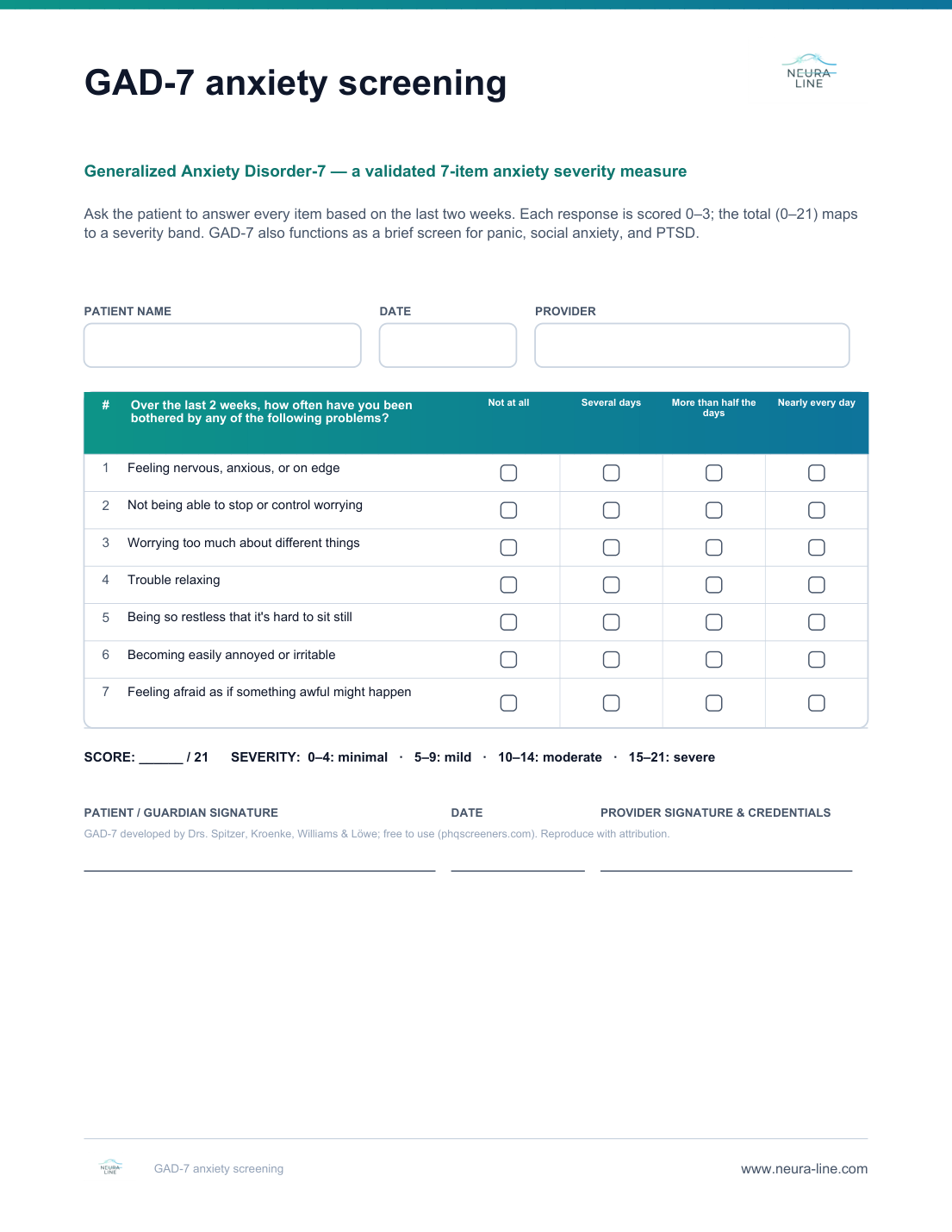
The validated 7-item anxiety measure with 0–3 response columns and severity bands (0–21) — the standard anxiety screen paired with PHQ-9 in measurement-based care.
Superbill templates, Good Faith Estimates, intake packets, and fee-schedule worksheets for running a therapy practice. New templates are added regularly — book a demo to get early access.
Get accessWhat to document and what to skip, the time-based CPT rule that drives billing, common mistakes that cause denials, and how AI charting cuts note time by 60%.
Read guideThe three documentation formats compared — when each fits best, what auditors look for, and why consistency matters more than format.
Read guideTime-based psychotherapy codes, add-ons, and the documentation rules that keep behavioral health claims paid.
Read guideThe practical checklist for staying HIPAA-compliant — BAAs, access controls, documentation, and breach-prevention basics.
Read guidePricing, AI charting, e-prescribing, and billing compared head-to-head — which platform fits which practice type.
Read guideNeuraline, TherapyNotes, Jane App, DrChrono, and more — pricing, features, and best-fit use cases compared.
Read guideItem-by-item response scale, severity bands (0–27), the ≥10 positive cutoff, and the item-9 suicide-risk flag workflow.
Read guideItem-by-item response scale, severity bands (0–21), the ≥10 positive cutoff, and pairing with PHQ-9 for measurement-based care.
Read guideFast-lookup tables of DSM-5-TR diagnoses with ICD-10-CM codes and core criteria — mood, anxiety, trauma, OCD, neurodevelopmental, psychotic, and substance use.
Read guideDiagnostic criteria for ADHD, PTSD, and OCD in scannable tables — plus ASRS, PCL-5, and Y-BOCS screening cutoffs and the screen-to-diagnosis workflow.
Read guideFree printable 2-page desk reference — top outpatient DSM-5-TR diagnoses with symptom counts, duration thresholds, ICD-10-CM codes, and paired screeners.
Get access
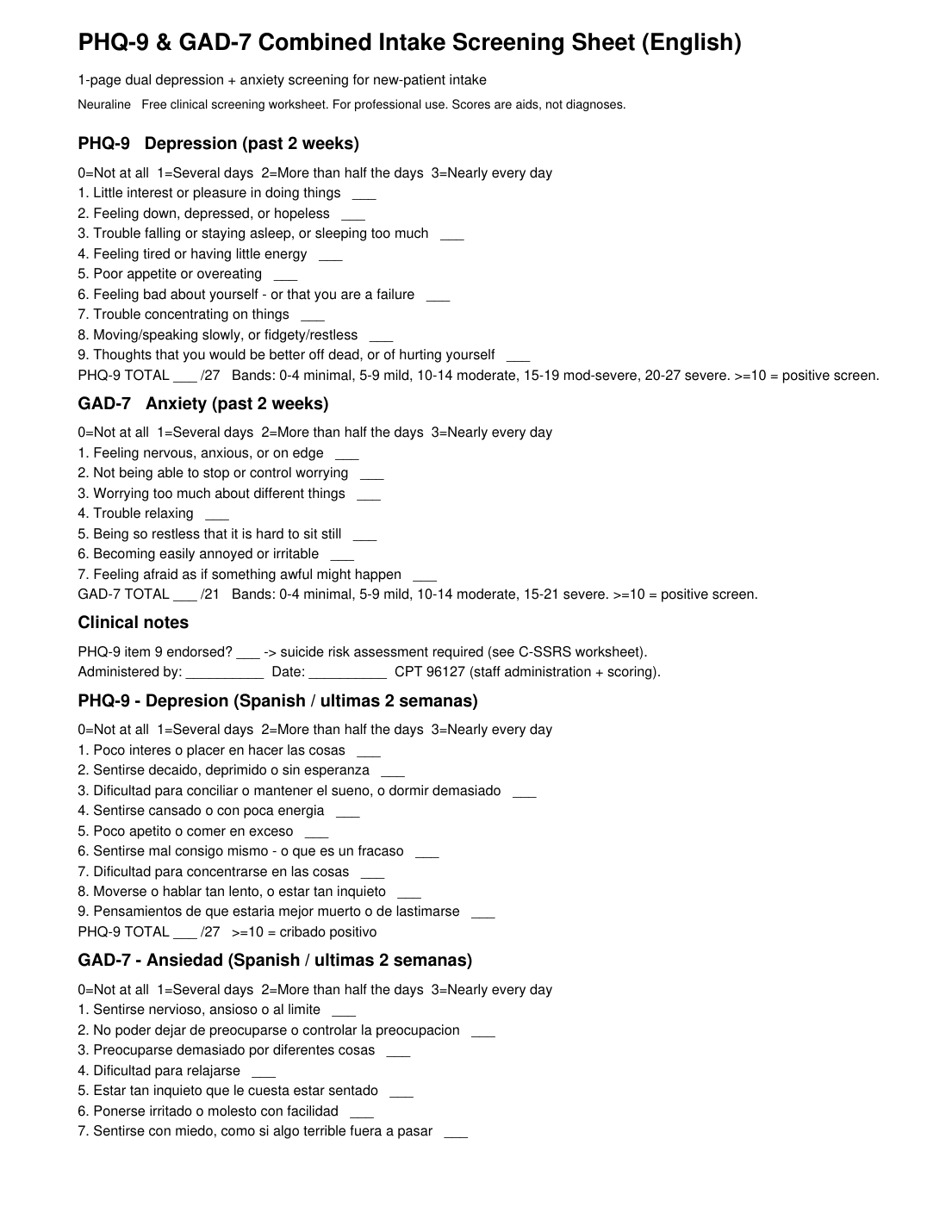
1-page dual depression + anxiety screening worksheet for new-patient intake — full PHQ-9 and GAD-7 items with scoring bands, English and Spanish.

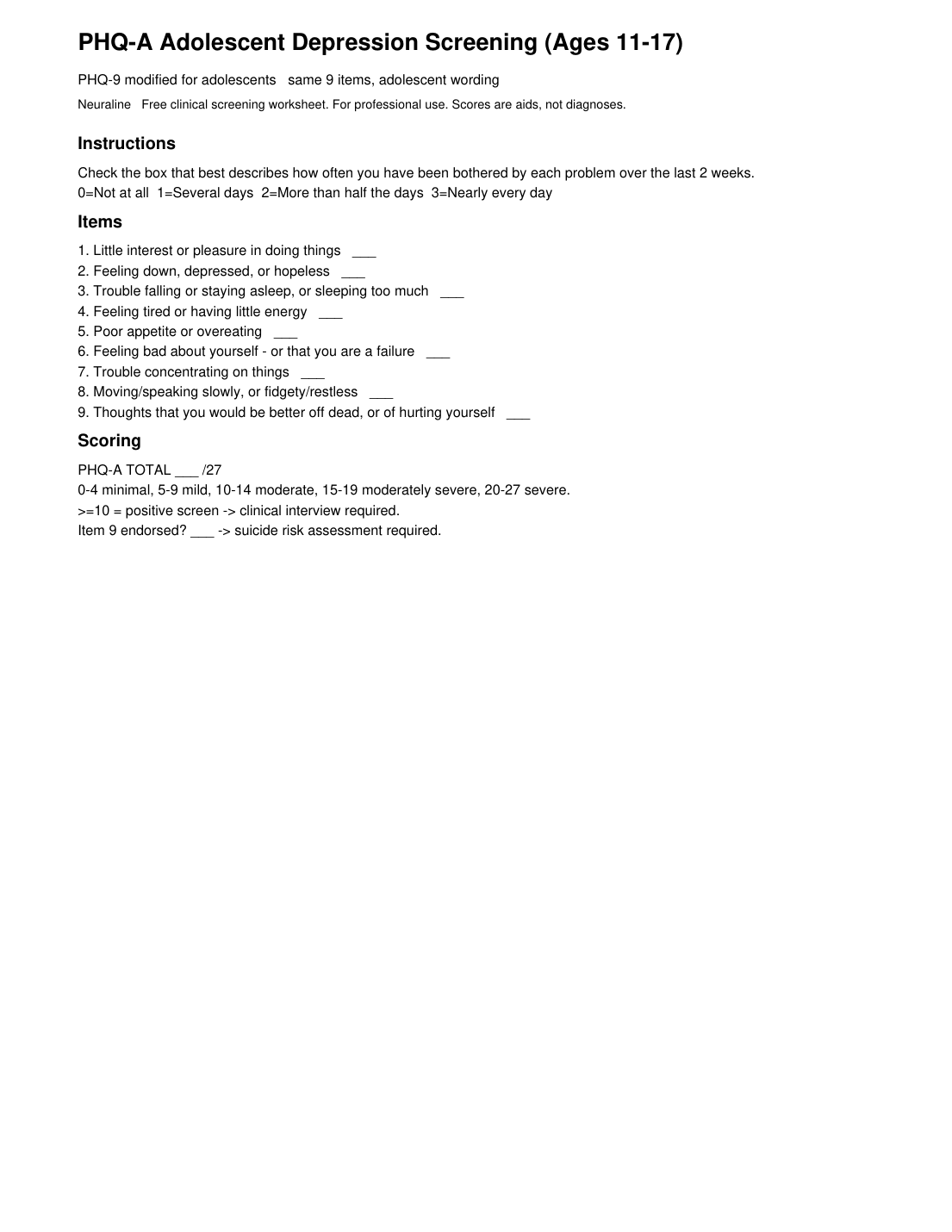
PHQ-9 modified for adolescents — 9 items, 0–27 scoring, severity bands, and the item-9 suicide-risk flag for ages 11–17.

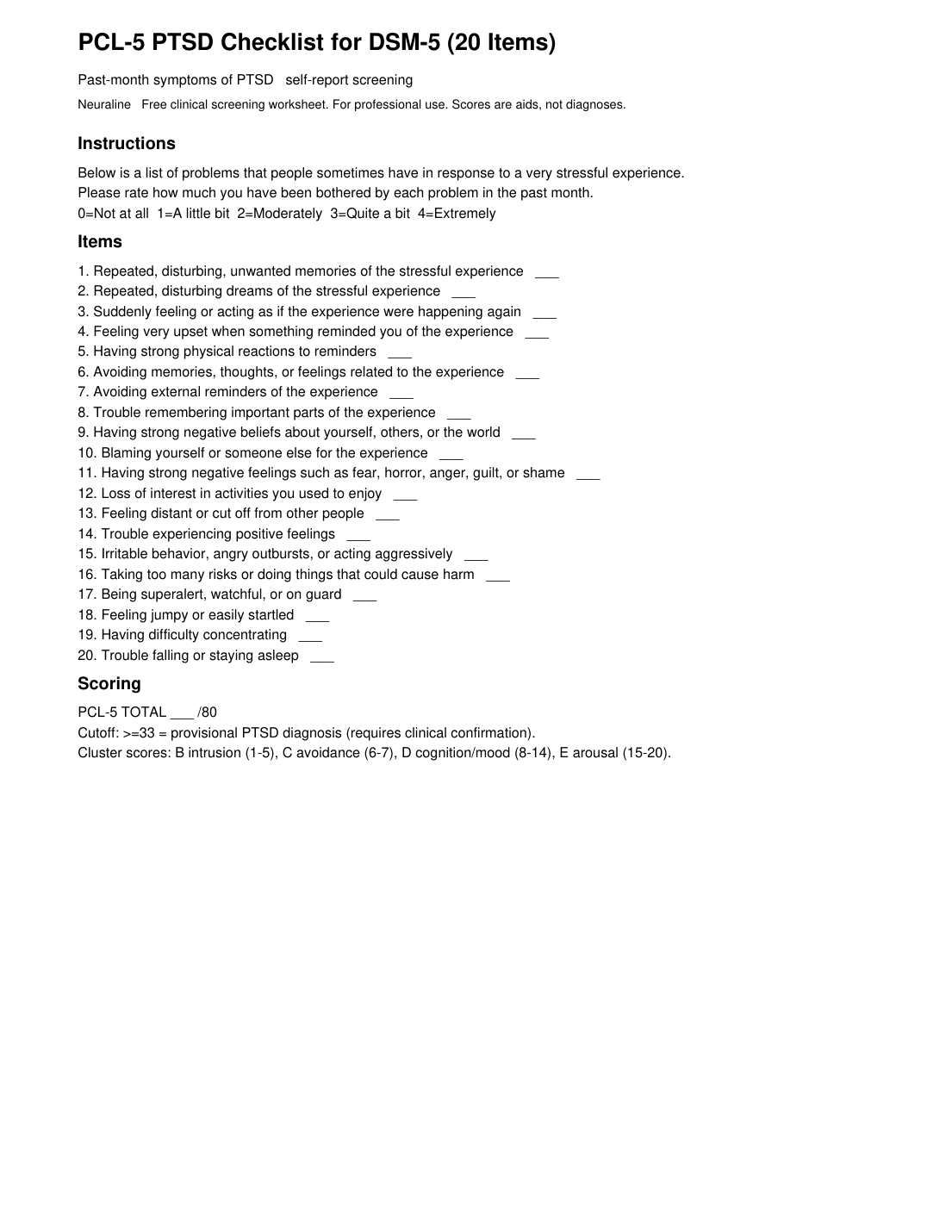
20-item PTSD checklist mapping to DSM-5 criteria clusters — 0–80 scoring with the ≥33 provisional-diagnosis cutoff and cluster subtotals.

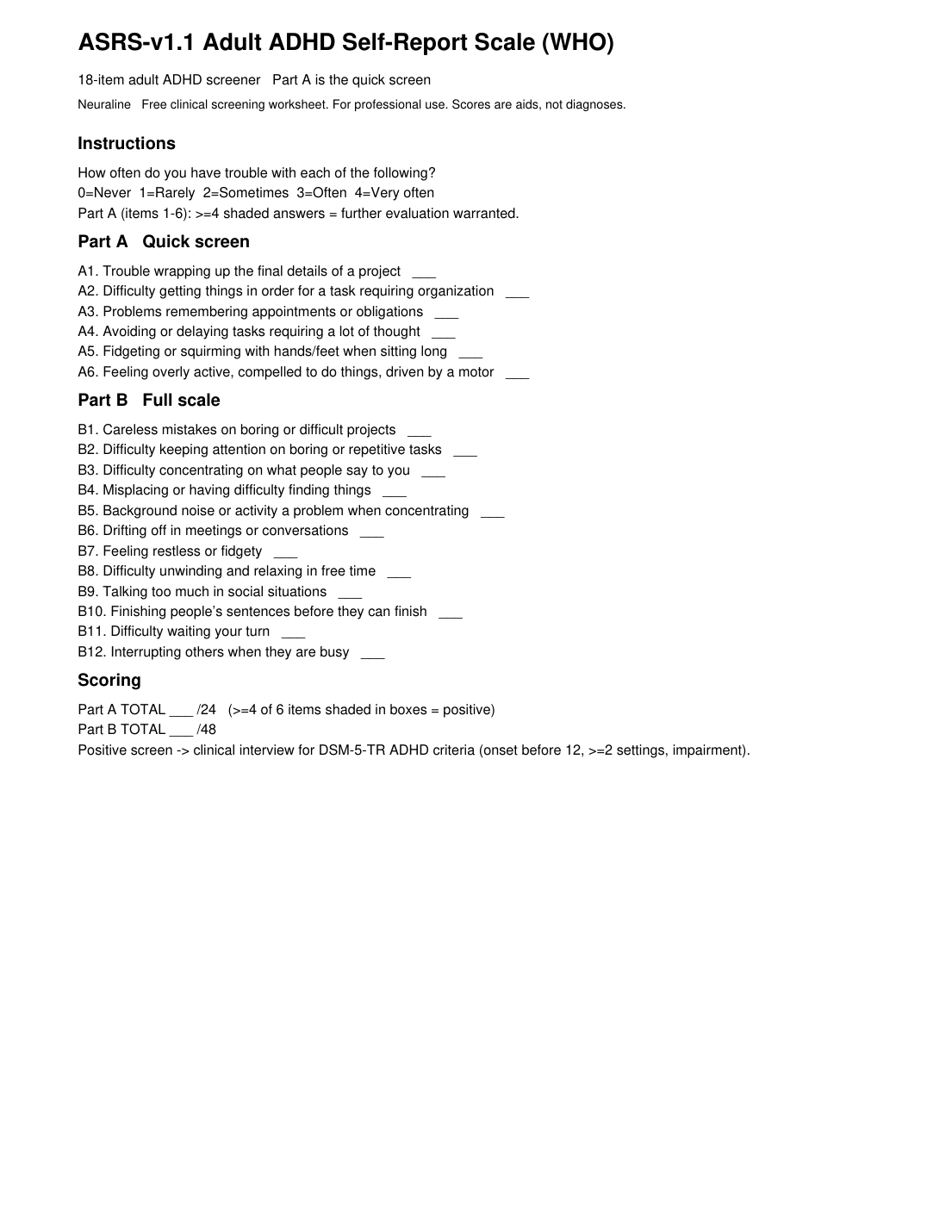
WHO Adult ADHD Self-Report Scale — 18 items with Part A quick-screen threshold (≥4) and full-scale scoring for ages 18+.

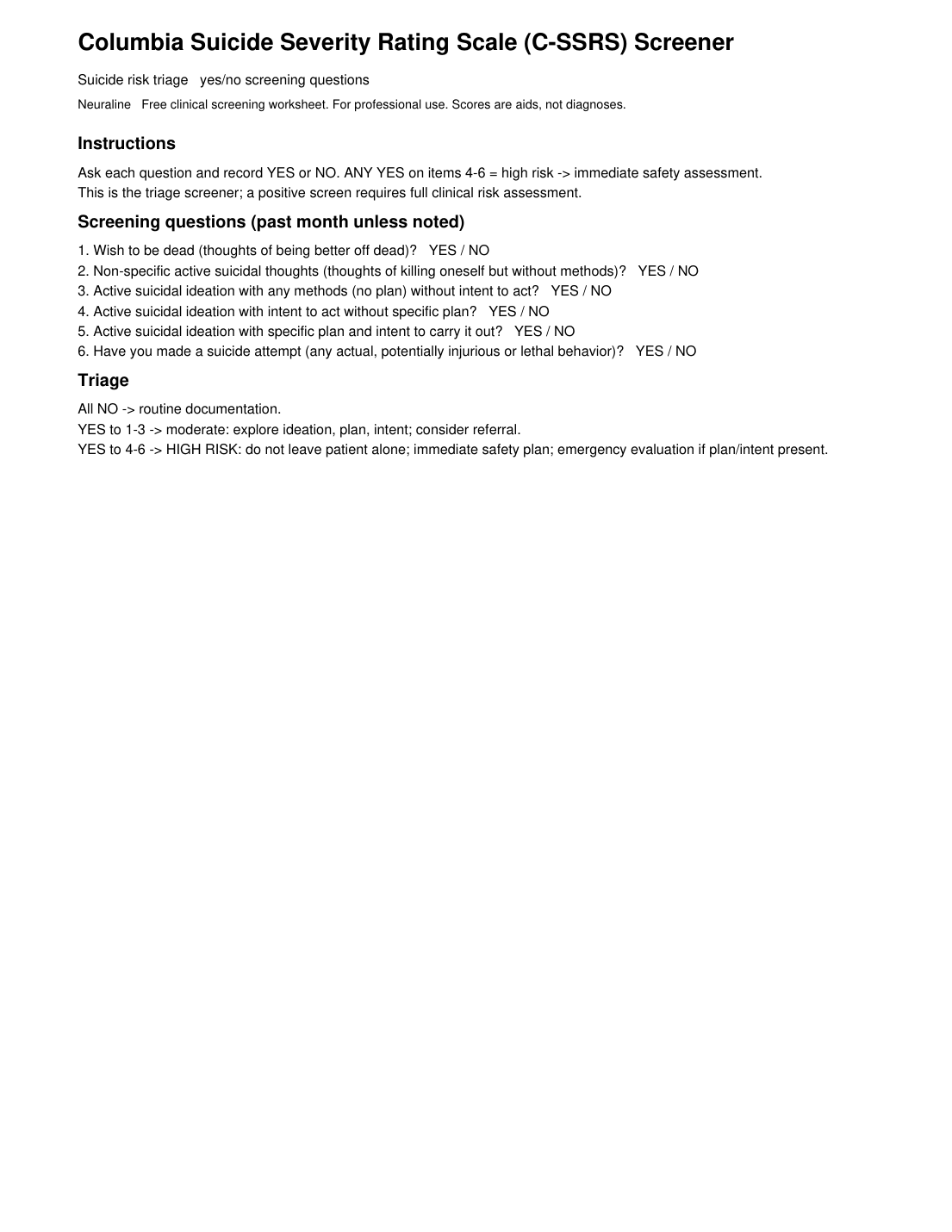
C-SSRS yes/no triage screener — 6 screening questions with risk stratification and immediate-action triage guide.
Every printable clinical screening worksheet in one place — depression, anxiety, PTSD, ADHD, suicide risk, perinatal, and bipolar instruments with scoring guides.
Get accessInteractive AWV health risk assessment template — PHQ-2 with conditional PHQ-9, ADLs/IADLs, fall/driving safety, G0438/G0439 billing, CPT 99483 escalation.
Get accessPublic-domain 11-item cognitive exam with education-level scoring bands — detects mild cognitive impairment earlier than the MMSE.
Get accessComprehensive psychiatric MSE template covering all 10 domains with structured fields, guided descriptors, and copy-to-SOAP summary.
Get accessStandalone 13-item MDQ bipolar screener with live scoring — ≥7 symptoms + same-time co-occurrence + moderate/serious impairment = positive screen.
Get access10-item OCD severity scale (5 obsession + 5 compulsion domains, 0–40) with live band scoring — subclinical through extreme.
Get accessClinical Y-BOCS reference — severity bands, serial-score treatment tracking, and CPT 96127 billing workflow.
Get access18-item OCI-R self-report scale (0–72, ≥21 positive) — fast OCD screen and Y-BOCS alternative with live auto-scoring.
Get access21-item BDI-II depression measure (0–63) with severity bands minimal/mild/moderate/severe, cutoffs, and PHQ-9 comparison.
Get access21-item BAI anxiety measure (0–63) with severity bands, cutoffs, and pairing guidance vs the GAD-7.
Get access
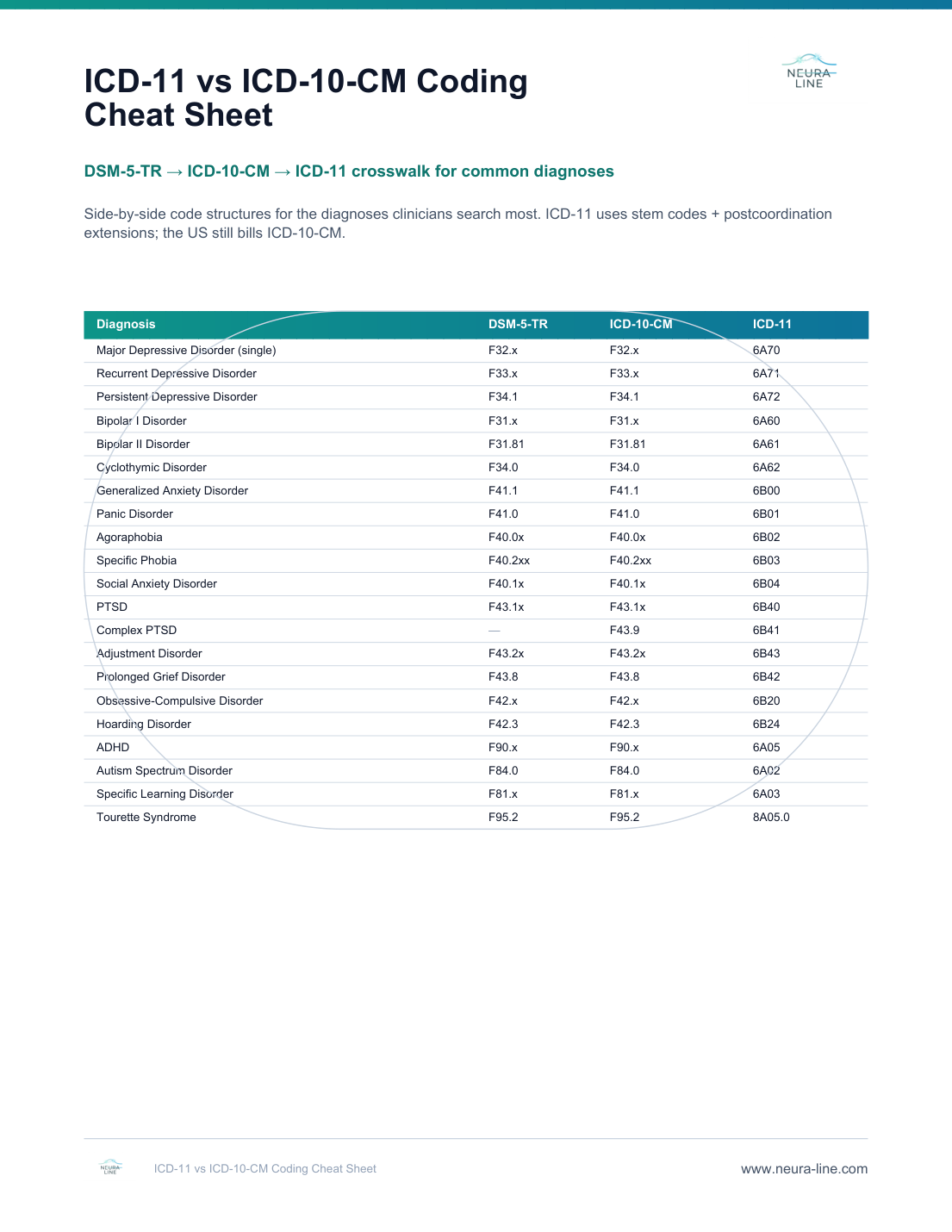
Interactive DSM-5-TR → ICD-10-CM → ICD-11 translator for 35+ diagnoses plus the code-structure cheat sheet and US transition timeline.
Get accessICD-10-CM codes for the top outpatient mental health diagnoses — specifiers, severity digits, episode rules, and denial-prevention coding traps.
Get access
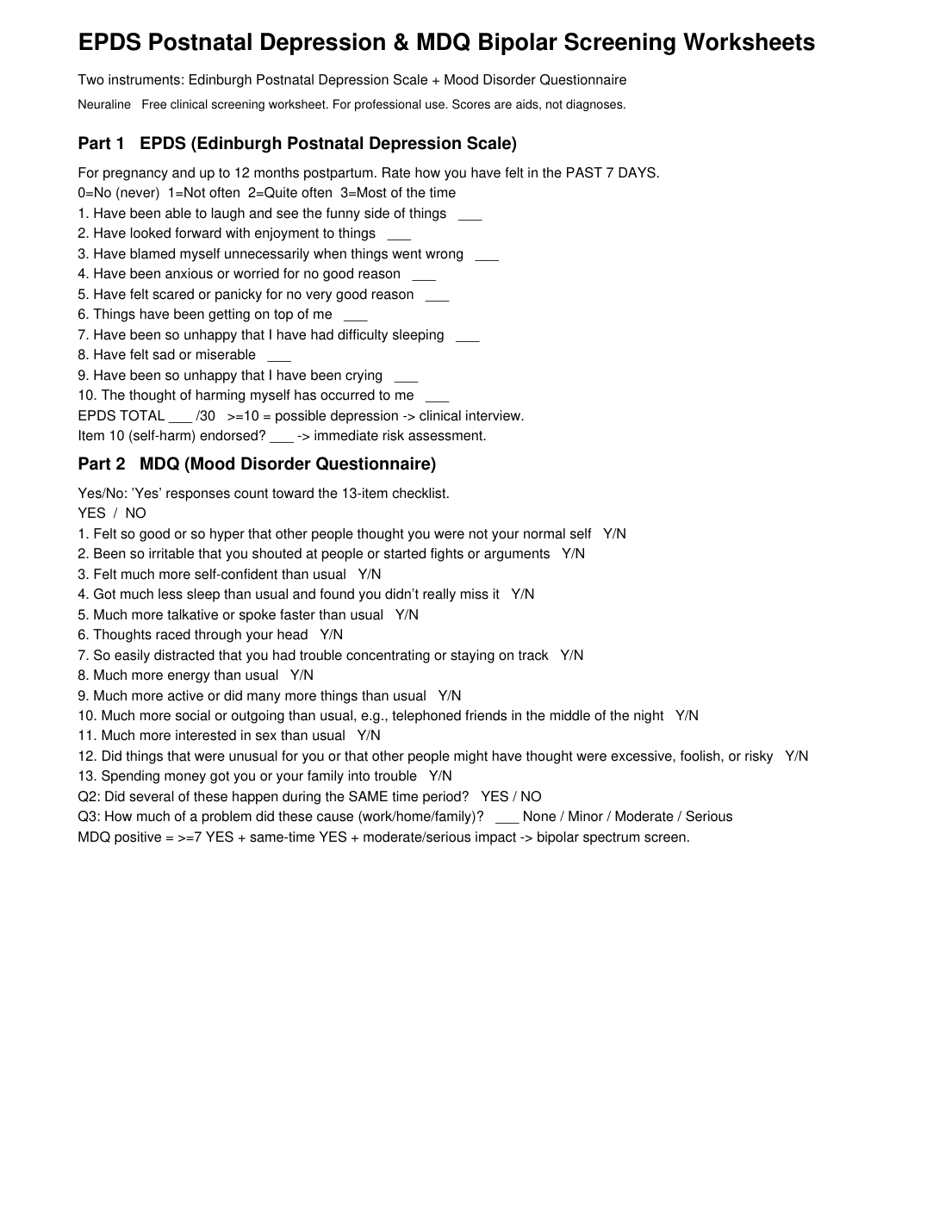
Two instruments in one PDF — Edinburgh Postnatal Depression Scale (10 items, 0–30) and Mood Disorder Questionnaire (13 items + impact questions).
Neuraline drafts SOAP, DAP, and BIRP notes automatically — review, edit, sign. Save 30–60 minutes of documentation every day.